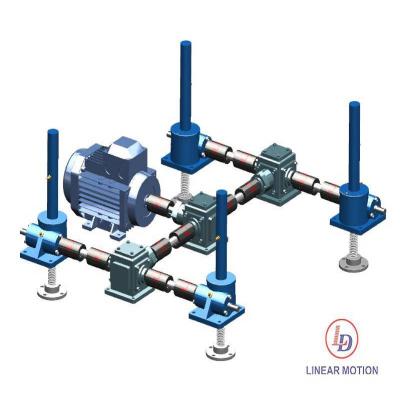
How to Choose the Right Screw Jack
Mar 05 , 2026
Why Screw Jack Selection is So Important
Common Risks of Improper Selection
Overload Damage (The Most Fatal Risk)
Screw bending: The housing cracks, causing instantaneous failure of the entire transmission system, potentially leading to a complete load drop.
Insufficient Accuracy
If the required accuracy cannot be met during operation, prolonged use will cause functional failure of the equipment, or even render it unusable.
Severe Overheating
Sustained high temperatures in the motor will accelerate the aging of the insulation. High temperatures may also cause thermal deformation of materials, further affecting equipment accuracy and product lifespan.
Safety Hazards
If the self-locking function of the equipment is insufficient, it will automatically slide down after a power outage, potentially causing the entire platform to tip over, increasing equipment costs, and in severe cases, leading to personal injury or death.
Inadequate protection levels in outdoor environments may shorten the service life.
4-Step Selection Overview
1. When selecting a screw jack, it is essential to clearly define the load parameters, accurately calculate the rated load, and determine the direction and angle of force to avoid risks caused by overloading.
2. Determine the screw type and motor power based on speed and usage frequency.
3. Select the head type based on the installation space, allowing for sufficient travel.
4. Determine the self-locking function and protection level based on the working conditions.
Step One – Determining the Required Load Capacity
Difference between Static and Dynamic Load
Static Load: The constant weight on the screw jack when the equipment is stationary, without movement or impact.
Dynamic Load: The actual load on the equipment during lifting and lowering; it includes the static load plus the frictional resistance of movement.
Impact Load: Instantaneous overload caused by collisions or material falling during start-up and shutdown. Therefore, when selecting a screw jack, it is generally multiplied by 1.2-2.0. The total load must be fully included in the rated capacity. The total load must include static load, dynamic load, impact load, and inertial force, all of which must be taken into account in the rated capacity of the screw jack to ensure safe and reliable screw jack selection.
How to determine the safety factor:
Recommended range:
* Normal operating conditions: Smooth operation, no impact, light to moderate use, recommended safety factor 1.25–1.5
* With impact: Large vibration, rapid start/stop, eccentric force, recommended safety factor 1.5–2.0+
* Personnel-related equipment: Personnel, stage, lifting platform, public equipment, recommended safety factor 2.5-3.0
Single and multi-unit linkage systems:
* Key considerations:
* Uneven load distribution, machining errors, installation deviations, uneven ground can all lead to overload of a single jack, resulting in damage to one unit and overall failure.
* Synchronization error: Inconsistent speed and displacement can cause platform tilting, which in severe cases can lead to compromised accuracy and safety.
* Structural rigidity: Insufficient rigidity of the frame, base, and connecting beams will amplify asynchrony and eccentric loading, exacerbating vibration and fatigue damage.
For multiple systems, special attention needs to be paid to load distribution.
Step Two – Determining Stroke and Operating Speed
Required Stroke: When selecting a screw jack, the stroke directly determines the structural dimensions and stability.
Define the maximum lifting height and allow for a safety margin.
Define the installation space to avoid collisions.
Speed Requirement Analysis
Speed Selection Logic:
High-speed operation → Prefer ball screw
Low-speed heavy load → Trapezoidal screw is safer (trapezoidal screw has a self-locking function)
Manual vs. Electric
Select manual input or electric input based on speed and torque.
Low speed and low torque are suitable for manual input; otherwise, choose electric input.
Step 3 – Evaluate Duty Cycle and Operating Frequency
What is Duty Cycle?
Definition: Running time ÷ Total cycle time
Closely related to heat generation. Directly related to heat generation, temperature rise, and lifespan.
Duty cycle is essentially limited by heat dissipation capacity and is one of the core criteria for screw jack selection.
Typical Duty Cycles for Different Types
Type Typical ED Trapezoidal Screw Worm Gear ~20%
Ball Screw Worm Gear ~30%
Bevel Gear Ball Screw Up to 85%
Ball screws are more suitable for high-frequency continuous operation. Step Four – Choosing the Right Type of Screw Jack (Core)
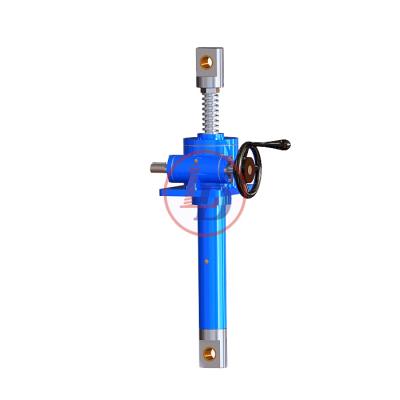
H3: Trapezoidal Screw Jack (Machine Screw Jack)
Advantages:
* **Good Self-Locking:** Trapezoidal screw jacks utilize sliding friction transmission, with a transmission efficiency typically between 30% and 50%. When the efficiency drops below 35%, self-locking is achieved naturally. This means that after power failure or cessation of input power, the load position automatically locks, preventing slippage without additional braking devices.
* **High Load Capacity:** The trapezoidal screw structure possesses excellent static load capacity, capable of withstanding large axial loads and short-term overloads, with a wide rated load range.
* **Lower Cost:** Compared to ball screw jacks, trapezoidal screws have a simpler structure, mature processing technology, and lower manufacturing costs. The purchase price is approximately 50%–70% of that of ball screw products with the same load capacity. Maintenance costs are also low, requiring only periodic grease replenishment.
Applicable Scenarios: Low speed, heavy load, power outage requiring position holding, manual system
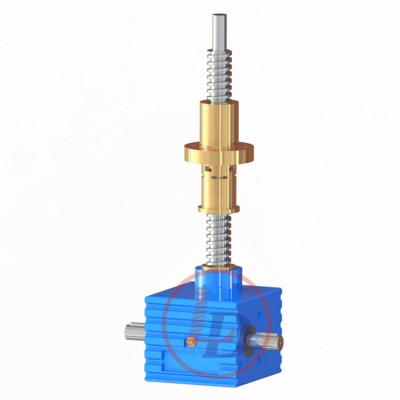
Ball Screw Jack
Advantages:
High Efficiency: Ball screws utilize rolling friction, achieving a transmission efficiency of over 90%, higher than the 30%–50% of trapezoidal screws. This means that under the same load, less drive power is required, allowing for smaller motors and a reduction in overall system energy consumption of over 30%.
High Speed: Due to low frictional resistance, ball screw jacks can achieve high-speed feed, with linear speeds up to 1500mm/min (25mm/s), and some customized models even reaching 46mm/s. Compared to trapezoidal screws, its start-stop response is faster, making it suitable for high-frequency start-stop applications.
High Precision: The ball screw assembly undergoes precision grinding, resulting in extremely low error. Positioning accuracy can reach ±0.05mm, with high-precision models achieving ±0.01mm. With the backlash-correcting device, the repeatability error can be controlled within ±0.005mm.
Note: It is usually not self-locking and requires a braking device.
Due to the high reverse transmission efficiency of ball screws, they cannot automatically lock the load after power failure, posing a risk of slippage. Therefore, in vertical lifting or high-safety-requirement scenarios, a brake motor or an external self-locking device must be installed to prevent accidents.
Applicable Scenarios:
Automated equipment, high-frequency operation, precision positioning conditions
Common Selection Errors
* Misconception that all screws can self-lock, ignoring safety risks.
* Directly selecting ball screws in vertical lifting systems without adding a braking device. The load slips after power failure, posing a serious safety hazard.
* Focusing only on load and not speed leads to an imbalance in transmission efficiency.
* Selecting trapezoidal screws in high-speed automated production lines to pursue low cost. High friction, severe heat generation, drastically reduced lifespan, and frequent motor overload alarms.
* Confusing "static load" with "dynamic load," leading to structural failure.
* Using trapezoidal screws to bear impact loads (such as frequent starts and stops, sudden stop collisions). Stress concentration at the thread root can cause lead screw deformation or even breakage.
Ignoring the effects of off-center loading can lead to lead screw bending or jamming. Misalignment during installation or a shift in the load center of gravity, yet calculations are still based on axial loads, can cause the lead screw to bear bending moments, resulting in deflection, increased local contact stress, accelerated wear, and even jamming.