

what are you looking for?
The core reason why screw jacks have become indispensable products in industry and daily life lies in their ingenious transformation of minute rotational forces into a linear lifting force capable of moving hundreds of tons through the screw thread—a "sloping surface wrapped around a cylinder." It doesn't rely on hydraulic oil pressure, but purely on the physical self-locking characteristics of its mechanical structure, ensuring that the load remains stable when suspended, eliminating the risk of sudden collapse due to pressure release. Its self-locking function makes it irreplaceable in scenarios with extremely high safety requirements.
What is a screw jack?
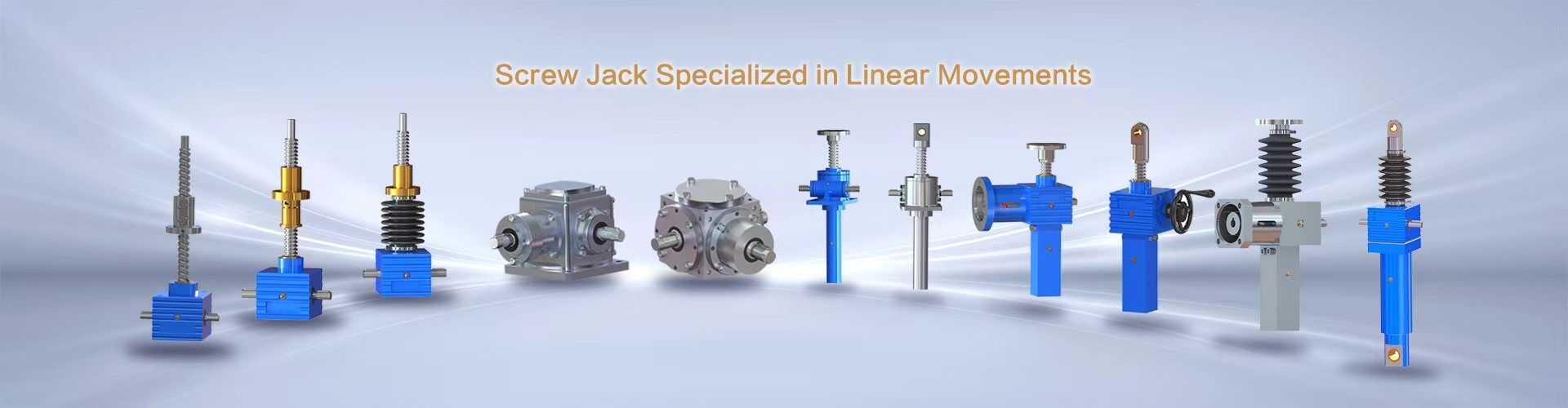
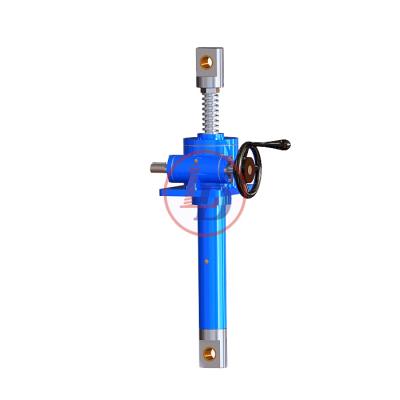
A screw jack, also known as a mechanical jack, is a manual lifting tool that converts rotational motion into linear lifting motion through a manually driven screw drive. It relies on the self-locking principle of the screw thread to support heavy objects. Despite its simple structure, it provides powerful lifting force, with a maximum lifting capacity of 100 tons or even higher. It is widely used in automotive repair, construction, equipment installation, and other fields.
Compared to hydraulic jacks, the core advantage of screw jacks lies in their safety and self-locking mechanism. The friction between the threads is sufficiently high that the weight cannot force the screw to rotate in the opposite direction. Even when operation stops, the weight remains stable in place, avoiding the slow depressurization and sinking problems common in hydraulic systems. Furthermore, it requires no hydraulic oil, is easy to maintain, and can operate stably in harsh environments such as low temperatures and dusty conditions, making it an ideal choice for applications requiring high safety and durability.
The Working Principle of Screw Jacks
The working principle of screw jacks is based on two classical mechanical principles: the inclined plane principle and the lever principle. The thread is essentially an inclined plane wound around a cylinder. Turning the handle is equivalent to slowly pushing the weight up along this "incline." The handle, utilizing the lever principle, amplifies the manual force into a torque sufficient to drive the screw to rotate.
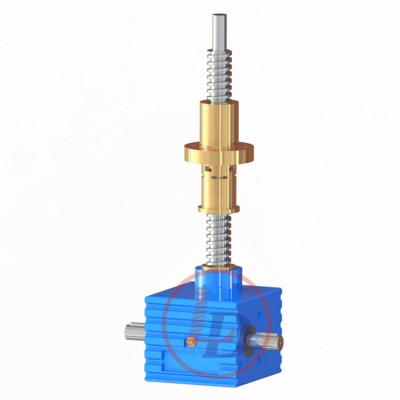
Specifically, when the handle is turned, the worm gear drives the worm wheel to rotate, which in turn drives the screw to rotate. Because the nut and screw threads are tightly engaged, the rotation of the screw forces the nut to rise axially, thus lifting the weight. This is the nut movement pattern of a screw jack. Ordinary screw jacks rely on the self-locking of their threads to maintain the position of the load. To ensure safe use, ball screw jacks are equipped with an additional brake. Once released, the load's own weight allows for rapid descent, improving work efficiency.
Core Components of a Screw Jack
A screw jack has a simple and robust structure, mainly composed of the following components:
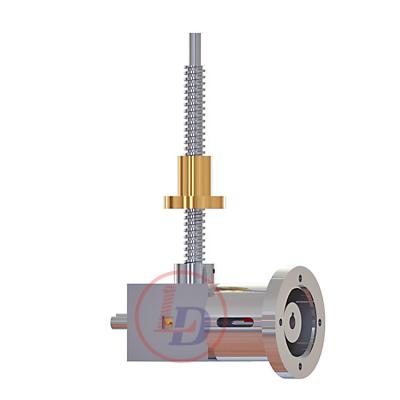
1. Screw: The core component made of high-strength alloy steel. It achieves lifting and lowering through rotation and bears the main lifting force. Lude Transmission screws are available in materials such as 45 steel, 304 stainless steel, and 316 stainless steel.
2. Nut: Engages with the screw thread, converting rotational motion into linear displacement, pushing the load upwards.
3. Handwheel: The handle provides operating force, while the internal worm gear transmission group is responsible for speed reduction and torque amplification, making lifting easier.
4. Worm Gear: The meshing of the worm gear and worm converts rotational force into linear motion force. The worm gear is primarily made of tin bronze, while the main materials for the worm wheel itself are 45 steel and 20CrMnTi alloy steel.
Application Scenarios of Screw Jacks: Screw jacks are used in scenarios centered around their characteristics of "long-term stable load-bearing capacity and strong environmental adaptability":
1. Automotive Repair: They are the preferred tool for changing tires and overhauling chassis in passenger cars. Their self-locking feature ensures the safety of personnel working under the vehicle, avoiding the potential pressure leakage risks associated with hydraulic jacks.
2. Building and Bridge Construction: Used for steel beam installation, pier fine-tuning, scaffolding support, etc. They can work stably in dusty and gravel environments, and some models can even achieve short-distance lateral movement of heavy objects.
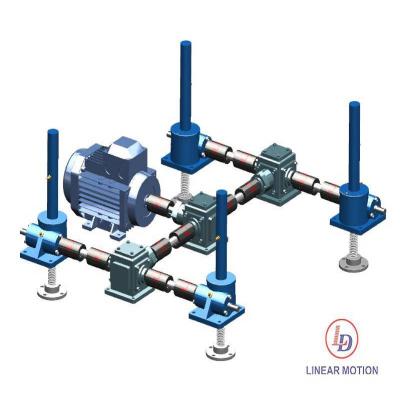
3. Equipment Installation and Debugging: Used in factory workshops for positioning and leveling machine tools and motors, achieving millimeter-level precise height adjustments to ensure equipment installation accuracy.
4. Heavy Object Handling and Temporary Fixing: In warehouses, when moving large shelves or heavy wooden crates, they can be used to lift objects to insert rollers; during logistics loading and unloading, they can temporarily support tilted goods to prevent tipping.
Safety Precautions for Using a Screw Jack:
1. Do not overload: Strictly adhere to the jack's rated load capacity to prevent overloading, which could cause the screw to bend or break.
2. Maintain verticality: Ensure the jack is vertical and stable during lifting to prevent accidents caused by screw tilting.
3. Control the stroke: The lifting height must not exceed the red warning line on the sleeve. For jacks without markings, the lifting height must not exceed 3/4 of the total height of the screw threads.
4. Regular maintenance: Clean surface dirt after use. Regularly lubricate threads and gears with grease, check parts for damage, and ensure smooth operation.