

what are you looking for?
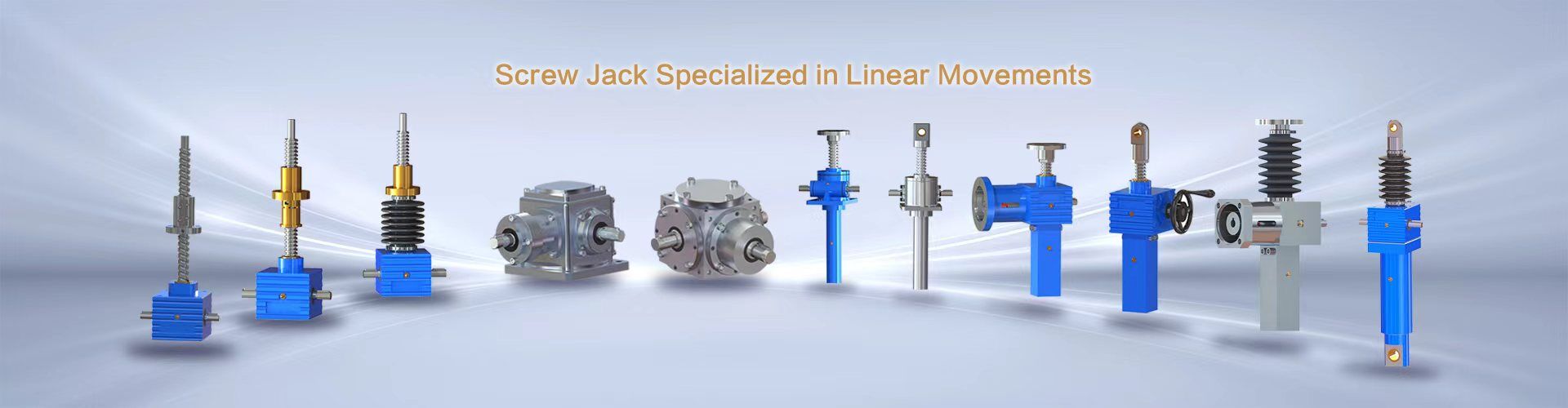
The 2-stage telescopic worm gear screw jack is a core linear transmission unit for industrial long-stroke lifting and precision fine jacking applications. Featuring a two-section telescopic spindle design, it delivers a large lifting stroke within a compact retracted installation envelope, solving the major limitation of conventional single-stage screw jacks where longer stroke requires a much longer closed height. It retains the classic strengths of worm-and-wormgear drive: inherent self-locking upon power cut, stable load carrying, flexible mounting options and wide adaptability. It is widely adopted in automated lifting tables, metallurgical furnace doors, building material presses, warehouse vertical lifting systems, sluice gate hoists and precision tooling adjustment stations.
Correct engineering selection is critical to secure stable operation and extend service life. Due to the nested telescopic structure, its load stability differs significantly from single-stage models, so dedicated selection rules must be .
Start with accurate load verification. Calculate dead weight of tooling & workpiece plus dynamic inertia load. For normal steady operation, dynamic factor = 1.2–1.5; for shock loading and frequent start-stop cycles, dynamic factor = 1.5–2.0. The rated capacity of the jack must exceed the total calculated load. Overloading is strictly prohibited. The telescopic spindle has weaker buckling resistance than single-stage spindles. We recommend selecting one size up for extra safety margin to avoid spindle deformation, thread jamming and premature wear under sustained heavy load.
The biggest advantage of 2-stage telescopic screw jacks is compact retracted height for long stroke. Confirm three key parameters: effective working stroke, closed retracted length and maximum extended length. When the ratio of extended spindle length to nominal spindle diameter exceeds 10, buckling calculation (Euler column formula) is mandatory. Long-stroke applications require external guide assemblies to absorb side force and prevent buckling failure. Check mounting configuration: top mounting, side mounting and inverted mounting create different force boundary conditions, which must match your mechanical layout.
Lifting speed and self-locking rely on the worm gear ratio. Higher ratio means slower speed and stronger self-locking. For sluice gates, holding fixtures and load retention requiring power-off anti-fall, choose gear ratio 8:1 or higher. For high-frequency fine adjustment and faster cycling, variable frequency or servo motors can be matched. Acme trapezoidal spindles come with built-in mechanical self-locking for low-speed heavy-duty holding. Ball screw versions offer higher efficiency for non-locking high-precision applications.
Standard cast iron units work for dry indoor conditions. For dusty, humid or outdoor environments, IP65+ protection, bellows boots and FKM sealing are available. Hot-dip galvanized coating or stainless steel construction is offered for corrosive and salt-spray conditions. For multi-jack synchronous lifting systems, connect with mechanical drive shafts or PLC synchronous control systems. Uneven load factor must be considered to guarantee leveling accuracy. Cooling and lubrication packages are selected according to duty cycle.
Follow the rule: size by load, structure by stroke, accessories by working condition. Balance safety, stability and cost, avoid common mistakes including under-sizing, stroke mismatch and insufficient protection, to achieve reliable long-term operation.
Q: What is the difference between 2-stage telescopic screw jack and single-stage screw jack?
A: It achieves long stroke with shorter closed height for limited installation space, while its buckling stability is lower, so stability check is required.
Q: Does the telescopic screw jack self-lock?
A: Acme spindle + high ratio worm gear provides self-locking. Ball screw models normally require brake motors.
Q: How to synchronize multiple telescopic screw jacks?
A: Mechanical shaft linkage or servo electronic synchronization, with guide supports recommended for uneven load.
Tags :