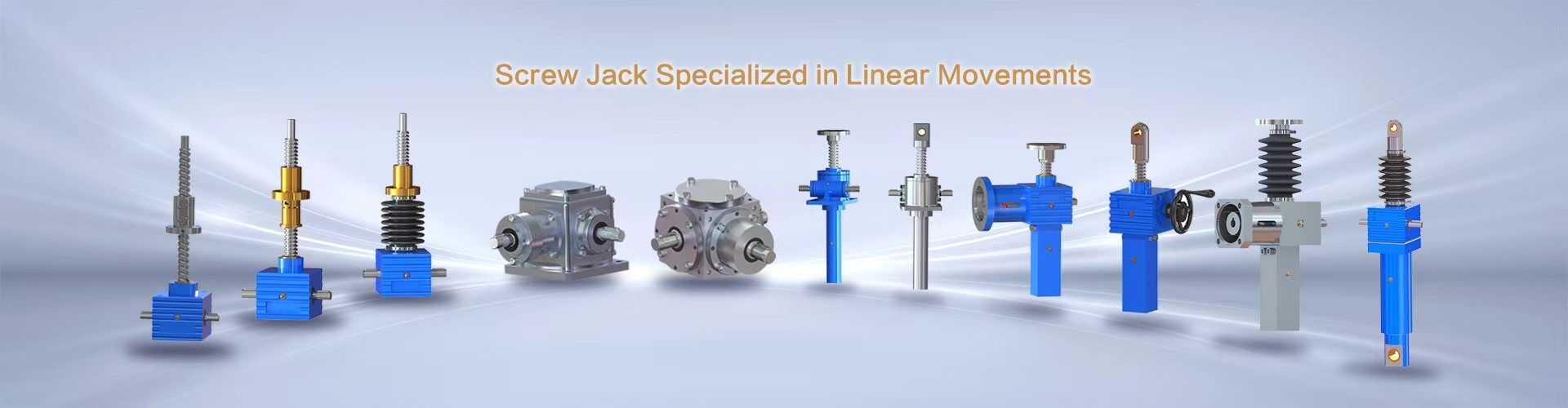
In the selection process, we often encounter situations where screw jack systems are used to replace hydraulic lifting systems. So, what are the connections and differences between the two?
1. Lifting System Stability: We all know that hydraulic lifting systems have safety hazards during use; hydraulic failure is their fatal weakness. Screw jacks, on the other hand, operate through the mechanical movement between a screw and a nut. They have a
self-locking function, which ensures safety in situations such as power outages, overloads, or disconnection of the drive source. Therefore, in this respect, screw jacks are better than hydraulic lifting systems.
2. Easy Installation and Simple Operation: Under the same load,
screw jack systems occupy significantly less space than hydraulic lifting systems. Screw jacks are easy to install and operate, offering significant advantages such as small size and high load-bearing capacity, far surpassing hydraulic lifting systems in this aspect.
3. Low Cost: Traditional worm gear screw jacks have excellent transmission capabilities and relatively low costs, serving the needs of various work environments and industries, with a wide range of applications. Compared to hydraulic systems, which require a hydraulic power unit to provide power,
hydraulic lifting systems are more expensive and have higher installation requirements. It can be seen that
screw jacks have better applicability than hydraulic jacks.
In summary, considering the above aspects, screw jacks offer better cost-effectiveness than hydraulic jacks. Furthermore, with the development of jacks, linear screw drive products suitable for more applications have emerged, making screw-driven lifting applicable to a wider range of situations.