

what are you looking for?
Single Screw Jack vs Synchronized Screw Jack System
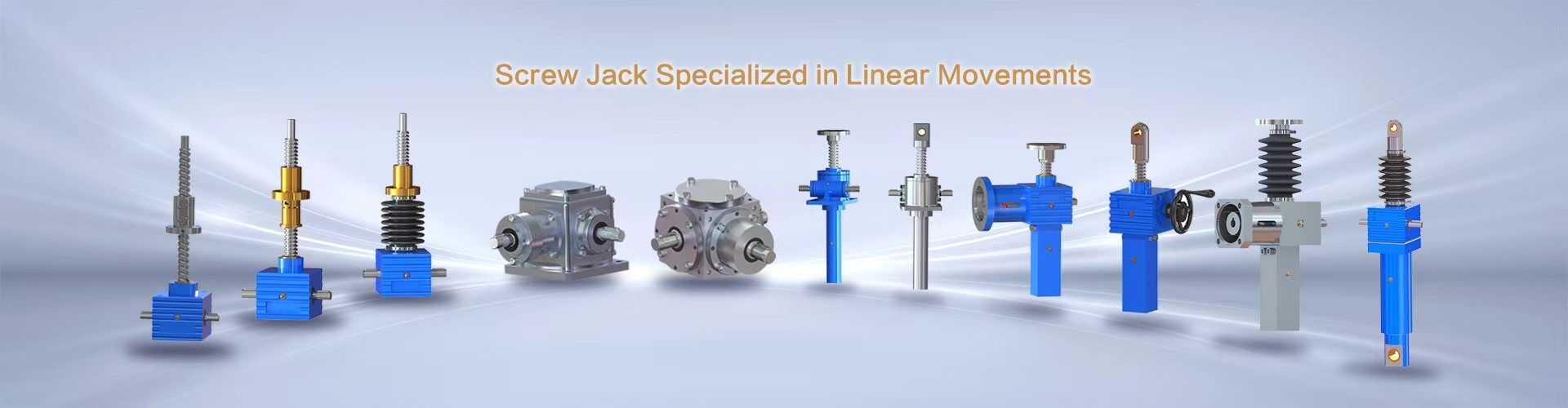
Screw jacks are widely adopted electromechanical linear lifting solutions across machinery, metallurgy, hydropower, solar, AGV and automation industries. Engineers often face a core decision: select a single independent screw jack or build a multi-point synchronized screw jack system. This article clarifies application scenarios, respective strengths, core advantages of Lude Transmission, and common technical FAQs to help you make the optimal selection.
1. When to use Single Screw Jack and when to adopt Synchronized Screw Jack System
Single Screw Jack
Choose a single screw jack when your load is concentrated at one lifting point, no multi-point leveling requirement.
Typical scenarios:
- Single-point push/pull, lifting or positioning of concentrated loads
- Simple height adjustment, manual or motor-driven independent actuation
- Compact installation space with only one force application point
- Low-budget, basic linear motion without platform horizontal control
Examples: mould fine adjustment, single-door pushing mechanism, small equipment height calibration.
Synchronized Screw Jack System
A synchronized system integrates 2, 3, 4 or more screw jacks, driven mechanically via bevel gearboxes and cardan shafts, or electronically controlled by PLC + encoders. Select it when:
- The load spans multiple supporting points and must stay horizontal during lifting/lowering
- Large platforms, heavy structures or wide-span frames require multi-point simultaneous movement
- Uneven distributed load and tilting risk exist if lifting points run independently
- Applications: hydraulic gates, solar tracking frames, stage lifting platforms, press tables, AGV lifting decks, large mould lifting systems.
Mechanical synchronization is preferred for fixed layout and high reliability. Electronic synchronization suits cases where long distances prevent rigid connecting shafts.
2. Advantages of Each Solution
Advantages of Single Screw Jack
1. Simple structure, fewer components, easy installation and commissioning.
2. Lower procurement cost, no extra bevel gearboxes, connecting shafts or control modules.
3. Flexible independent operation; each jack works separately without affecting others.
4. Light maintenance, simple lubrication and inspection routine.
5. Compact footprint, suitable for narrow spaces with only one linear motion axis.
Advantages of Synchronized Screw Jack System
1. Consistent stroke and speed across all lifting points, keeps platform level, prevents tilt and stress concentration.
2. Higher total load capacity, shares heavy weight over multiple jacks.
3. Modular layout (I/T/H/U configurations) to fit different platform shapes and site constraints.
4. Mechanical synchronous type works without complex electronic control, stable in harsh industrial environments.
5. Optional overload clutch, limit switches and encoders for safety interlock and closed-loop precision positioning.
3. Advantages of Ludian Transmission
Ludian Transmission specializes in designing and manufacturing standard and customized screw jacks and synchronized multi-jack systems, with ISO9001 and CE certification.
1. Full product portfolio: Supply SWL, SJA, DHB, DMB, JWM series trapezoidal & ball screw jacks, supporting translating screw and rotating nut types, load range from 2.5 ton up to 120 ton.
2. Complete synchronized system capability: In-house design for mechanical linkage schemes including T/H/U/I layouts. Provide matching bevel gearboxes, universal connecting shafts, torque limiters, limit switches and bellows protective covers. Both mechanical and PLC electronic synchronization solutions available.
3. High precision & reliability: Standard positioning accuracy reaches 0.1 mm; anti-backlash options can improve accuracy to 0.04 mm. Trapezoidal screw models have inherent self-locking to hold position after power-off for safety.
4. Strong customization capacity: Custom stroke, mounting flange, clevis end, special coating, sealing and non-standard housing for low/high temperature, dust and corrosive working conditions.
5. One-stop technical service: Professional engineering team assists load calculation, buckling check, system layout optimization and whole-system selection. After-sales technical guidance for installation, alignment and maintenance.
6. Cost-effective modular design: Short lead time for standard models; stable quality with long service life, widely exported to Europe, Russia, Southeast Asia, Middle East and Latin America.
A: Mechanical synchronization links all jacks via bevel gearboxes and cardan shafts driven by one motor. All jacks move at identical speed inherently, stable and low maintenance, ideal for fixed layout. Electronic synchronization uses separate motor + encoder for each jack, controlled by PLC. It suits long-distance separated lifting points but requires more electrical components and regular calibration.
A: It is not recommended. Independent motors have inherent speed deviation. Without closed-loop encoder feedback, height difference will accumulate during travel, causing platform tilt and extra bending stress on jacks and structure. If mechanical shafting cannot be installed, electronic closed-loop synchronous system is required.
A: Standard trapezoidal (Acme) screw jacks have self-locking function. The load will not fall when power cuts off, which improves safety. Ball screw jacks have high transmission efficiency but no self-locking; brake motor or external brake device must be equipped to avoid back-driving under load.
A: Please provide: total load, number & layout of lifting points, required stroke, lifting speed, working duty cycle, installation space, environment (temperature, dust, corrosion), mounting form, whether anti-backlash, limit switches or overload protection are required. Our engineers will perform load distribution and buckling calculation to recommend the proper model and complete system solution.