Applications of Screw Jacks in Lifting Platforms and Stage Systems
I. Why Modern Lifting Platforms Are Increasingly Relying on Screw Jacks
With the rapid development of industrial automation, intelligent manufacturing, and the large-scale stage equipment industry, the market has placed increasingly high demands on the stability, synchronization precision, and safety performance of lifting systems. While traditional hydraulic lifting systems offer substantial output force, long-term operation often leads to issues such as oil leakage, complex maintenance requirements, and significant synchronization errors. These limitations become particularly apparent in scenarios requiring high-precision positioning and multi-point synchronized lifting.
In contrast, screw jacks—thanks to their stable mechanical transmission structure, strong self-locking capabilities, and ease of synchronization control—are emerging as a vital solution for modern lifting platforms.
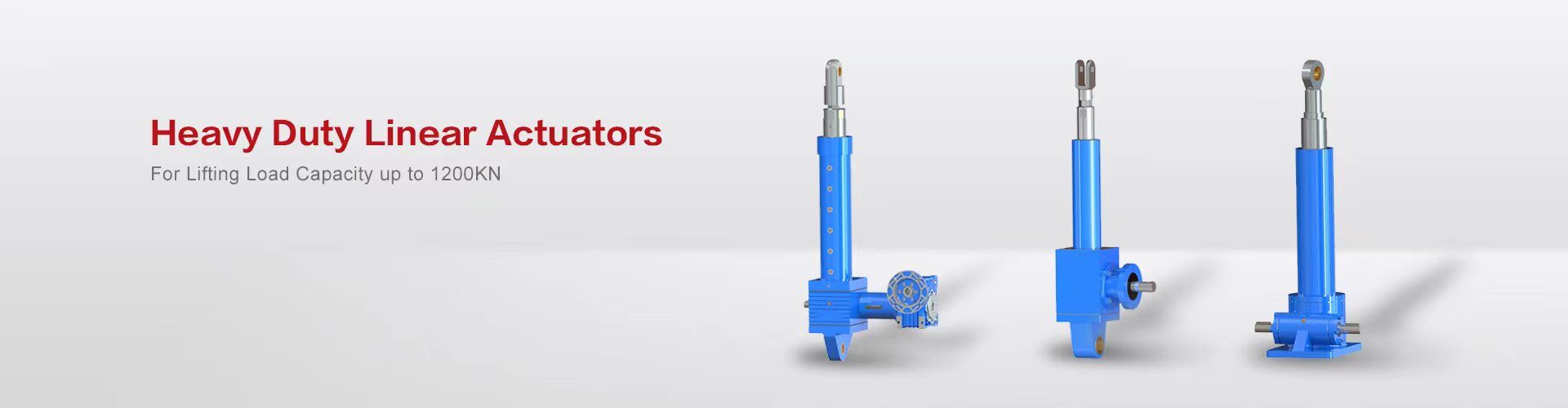
As a professional manufacturer of transmission and lifting systems, LudeTransmission has long focused on the fields of industrial lifting and synchronized transmission. We provide clients with a wide range of heavy-duty screw jacks, multi-point synchronized lifting systems, and customized stage lifting solutions, which are widely applied across industrial automation, logistics equipment, stage engineering, and heavy machinery sectors.
In the following application scenarios, screw jack systems have become the mainstream solution:
Stage Lifting Platforms
Automated Production Lines
Logistics Conveying Platforms
AGV Docking Systems
Heavy Equipment Lifting Platforms
Aerospace and Marine Maintenance Platforms
II. What is a Screw Jack?
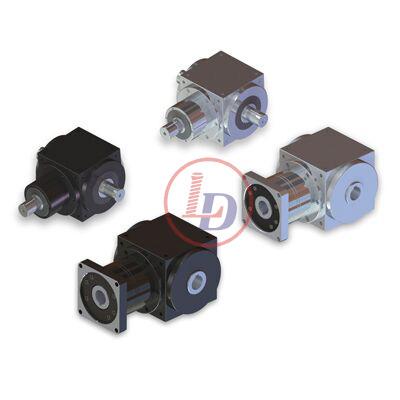
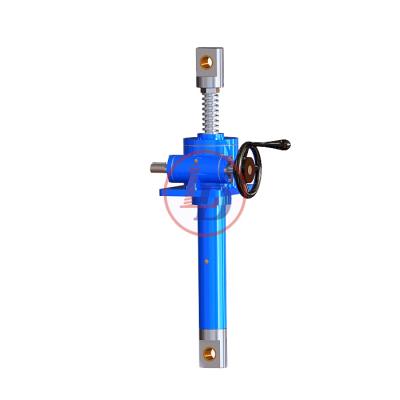
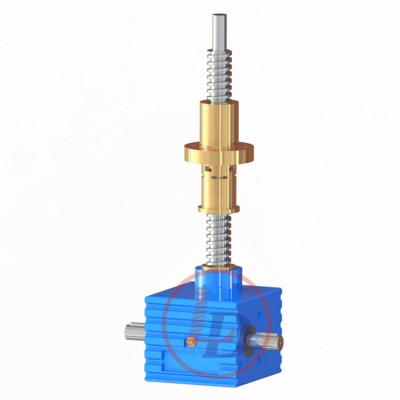
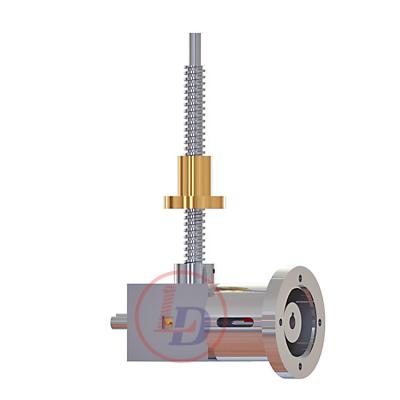
A screw jack is a mechanical device that utilizes worm gear or bevel gear transmission to convert the rotational motion of a motor into linear lifting motion.
Its basic operating principle is as follows:
Motor → Coupling → Reduction Gearbox → Screw Movement → Platform Lifting
1. Worm Gear Transmission Structure
Traditional screw jacks typically employ a worm gear reduction structure, characterized by the following features:
High output torque
Stable operation
Possesses self-locking capabilities
Suitable for low-speed, heavy-load operating conditions
This type of structure is particularly well-suited for industrial lifting platforms and stage equipment.
2. Translating vs. Rotating Screw Structures
Translating Screw Type:
The screw itself moves vertically (up and down); suitable for general lifting platforms.
Rotating Screw Type:
The screw rotates while the nut moves linearly; better suited for applications requiring long travel strokes. LudeTransmission can provide structural solutions tailored to specific customer requirements regarding travel length, installation space, and load capacity.
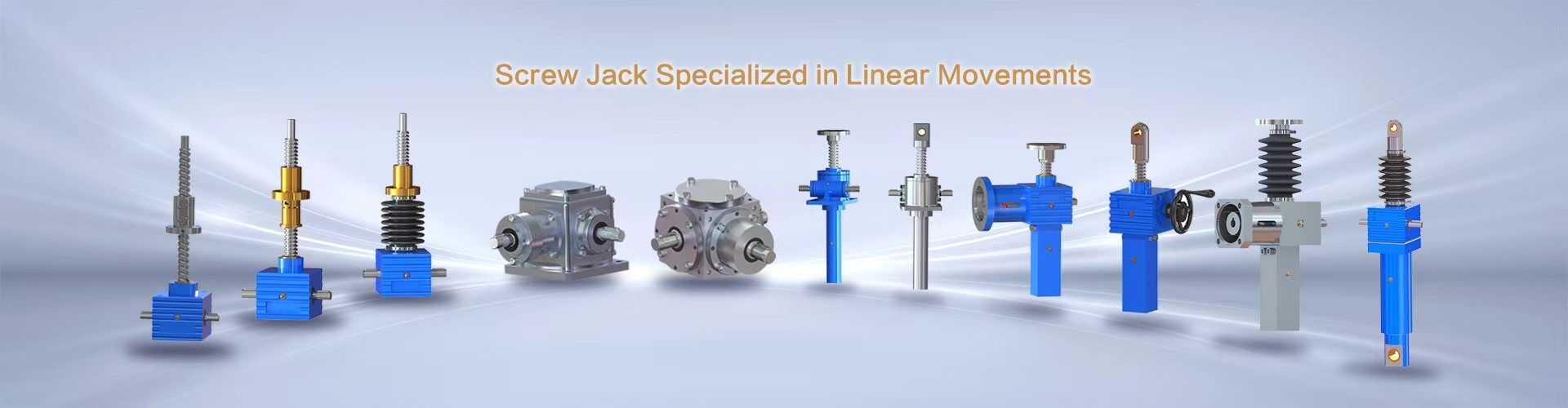
3. Common Types of Screw Jacks
Worm Gear Screw Jacks:
Economical and practical; features strong self-locking capabilities and is suitable for heavy-load, low-speed applications.
Ball Screw Jacks:
Offers high transmission efficiency and fast operating speeds; suitable for high-frequency operation.
Bevel Gear Screw Jacks:
Provides superior synchronization performance; suitable for multi-point linkage systems and frequently used in large-scale stage setups and automated equipment.
III. Applications of Screw Jacks in Lifting Platforms
1. Industrial Lifting Platforms
In the field of industrial automation, screw jacks are widely used in:
Heavy-duty equipment lifting
Automated assembly lines
AGV docking platforms
Precision positioning platforms
Compared to hydraulic systems, mechanical screw jack solutions offer higher precision in position control.
Key advantages include:
High load capacity
Strong self-locking performance
High-precision positioning
Multi-point synchronized operation
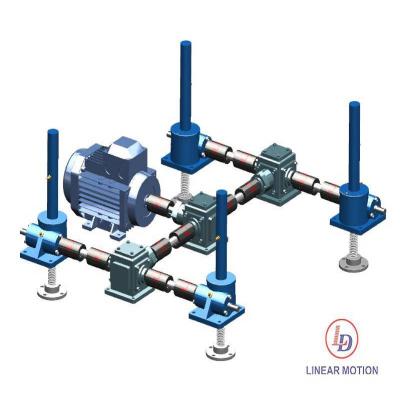
Lude Transmission can provide customized synchronized lifting systems, including solutions utilizing torque tube connections and multi-unit linkages.
IV. Applications of Screw Jacks in Stage Systems
1. Stage Lifting Platforms
Modern stage systems increasingly emphasize dynamic effects and safety performance.
Screw jacks are widely used in:
Concert stages
Theater stages
LED lifting stages
Rotating stages
Requirements for lifting equipment in stage systems include:
Smooth operation
Low noise levels
Precise synchronization
Prevention of stage tilting
In the field of stage lifting, LudeTransmission offers multi-point synchronized screw jack systems, supporting both servo control and position feedback systems.
2. Retractable Stage Systems
In recent years, the demand for retractable and concealed stage systems has grown rapidly.
Typical applications include:
Retractable grandstands
Pit-mounted lifting platforms
Concealed stage structures
Core technologies involved include:
Multi-unit jack linkages
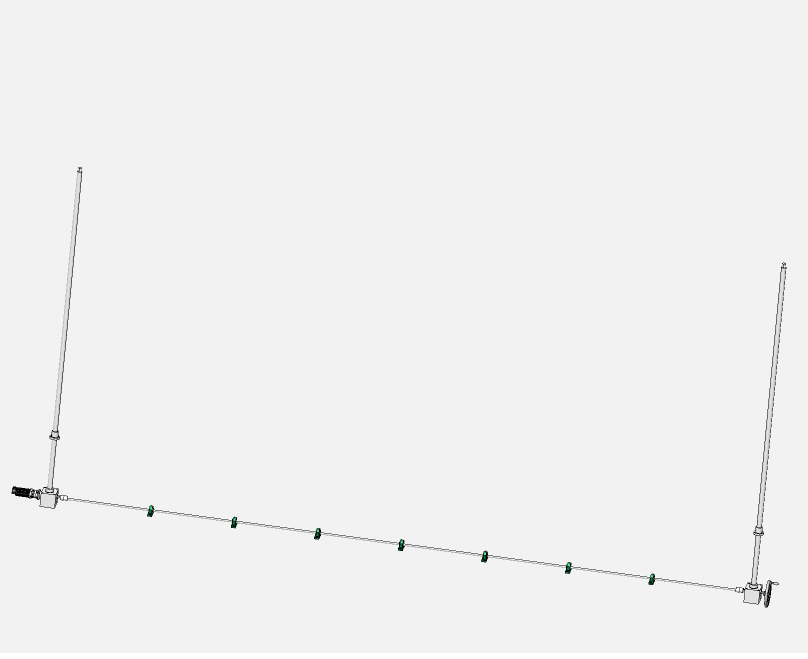
Torque tube synchronization systems
Long-distance transmission
For large-scale stage projects, Lude Transmission typically employs bevel gear synchronization solutions to enhance overall synchronization precision. 3. Why Do Stage Systems Prefer Lead Screws Over Hydraulics?
Compared to hydraulic systems, lead screw jacks offer higher positioning accuracy, lower maintenance costs, and more stable synchronization performance.
Lead screw jacks do not suffer from the oil leakage issues common in hydraulic systems; furthermore, they possess excellent self-locking capabilities, allowing the platform to maintain a stable position even in the event of a power failure. Consequently, they are better suited for applications with high safety requirements, such as stage systems.
Additionally, lead screw lifting systems make it easier to implement multi-point synchronized control, effectively preventing stage tilting and enhancing overall operational stability.
Therefore, in the fields of high-end stage engineering and automated platforms, mechanical lead screw lifting solutions are gradually replacing traditional hydraulic systems.
V. Core Technologies of Synchronized Lifting Systems
Large-scale platforms typically employ four-point or multi-point synchronized lifting structures.
Key technologies include:
Four-point synchronized lifting principles
Torque tube connection methods
Motor synchronization control
Limit switching and safety protection
Common synchronization schemes include:
Single-motor drive:
Suitable for small to medium-sized platforms.
Dual-motor drive:
Suitable for platforms with longer structural spans.
Multi-axis linkage systems:
Suitable for large stages and heavy-duty platforms.
Lude Transmission can provide complete synchronized lifting system designs and technical support tailored to specific client requirements.
VI. How to Select the Right Lead Screw Jack
Selecting the appropriate lead screw lifting system requires a comprehensive assessment of the following factors:
1. Load Capacity
Including:
Static load
Dynamic load
Eccentric load conditions
2. Stroke Length
For long-stroke applications, particular attention must be paid to:
Lead screw stability
Anti-buckling design
Guide mechanisms
3. Operating Speed
Standard Worm Gear Screw Jacks:
Suitable for low-speed, heavy-load applications.
Ball Screw Solutions:
Suitable for high-speed operations.
4. Drive Method
Common motor types include:
Three-phase asynchronous motors
Servo motors
Geared motors
Stage systems typically favor servo control to achieve higher synchronization precision.
5. Installation Environment
Factors to consider include:
Outdoor protection (weatherproofing)
Dust and corrosion resistance
High-temperature environments
Long-term continuous operation requirements
Lude Transmission offers customized solutions to accommodate a wide range of special operating conditions. VII. Common Questions and Solutions
Can screw jacks achieve synchronized lifting?
Yes. Through the use of torque tube linkages or servo control systems, multi-point synchronized lifting can be achieved.
What type of motor is typically used for stage lifting systems?
Three-phase asynchronous motors or servo motors are commonly used; however, high-end stage systems tend to favor servo control.
What is the maximum load capacity of a screw jack?
Depending on the specific model, the capacity can range from a few hundred kilograms up to tens of tons.