

what are you looking for?
Moving an aircraft hangar door is not a garage-door problem. A large hangar sliding door leaf can weigh ten to thirty tons, spans tens of meters, and must open and close reliably day after day, often under wind load and in dusty conditions. Hydraulic systems were once the standard answer, but they bring oil leaks, pump noise, high maintenance, and poor position control. Modern heavy-duty electric linear actuators replace hydraulics with clean, precise, servo-controlled motion, which is why hangar operators increasingly specify electric screw actuators over hydraulics.
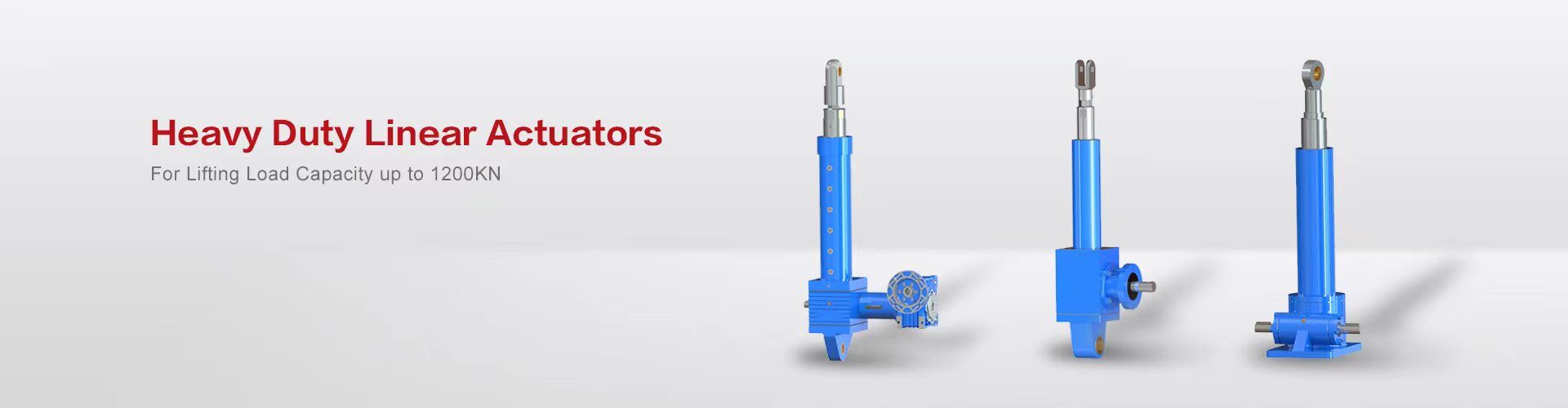
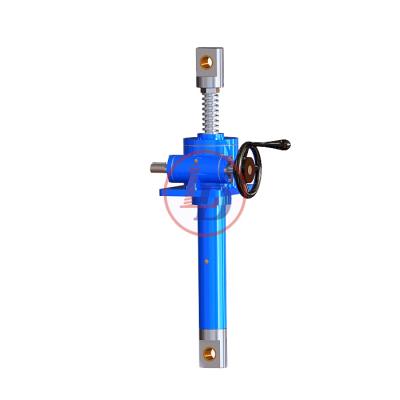
This article describes the Ludian Transmission LAP80 linear actuator with servo motor, engineered for a twin-unit synchronized aircraft hangar sliding door installation. Each unit delivers 50 kN (≈11,240 lbf) push and pull force, with an effective stroke of 1,100 mm and an adjustable operating speed of 8–16 mm/s. The two LAP80 units are mounted 17,370 mm (≈57 ft) apart on the door leaf and driven in synchronism by 220 V / 60 Hz servo motors — a configuration chosen to keep a multi-ton door square as it travels, since even a few millimeters of skew can rack the leaf and jam it in its tracks. The same setup powers side-opening hangar doors at facilities such as Cooper Aviation and Crop Dusters, where the leaf must clear the aircraft wing span and be operated cleanly and remotely.
Key specifications at a glance: 50 kN push/pull per unit (100 kN / ≈22,480 lbf combined); 1,100 mm effective stroke; 8–16 mm/s speed; spherical ball joint head ; AC servo motor, 220 V, 60 Hz; light duty, typically 1–2 open/close cycles per day; two units linked in master–slave synchronization.
Why 50 kN per unit? Rolling resistance of a sliding door is roughly door weight × track friction coefficient (μ ≈ 0.02–0.05 for roller systems). A 20,000 kg leaf needs only about 10 kN to roll, but wind load on a tall door face adds significantly, and the actuators must also overcome start-up friction and acceleration forces. At 100 kN total, the system carries roughly a 10× safety margin over normal rolling resistance — comfortable for wind, track debris, and bearing wear over the door's life.
Speed and cycle time. At 16 mm/s the 1,100 mm stroke takes about 69 seconds; at 12 mm/s about 92 seconds; at 8 mm/s about 138 seconds. A one-to-two-minute opening time suits aircraft taxiing and hangar operations, keeps acceleration forces low, and minimizes wear. Because the door runs only once or twice per day, the total running time is roughly 2–5 minutes daily — far below the 30% duty rating of the standard acme screw version. Compared with hydraulic cylinders, the electric actuator draws power only while moving; at standstill, energy consumption is near zero, and there is no oil to leak, filter, or replace.
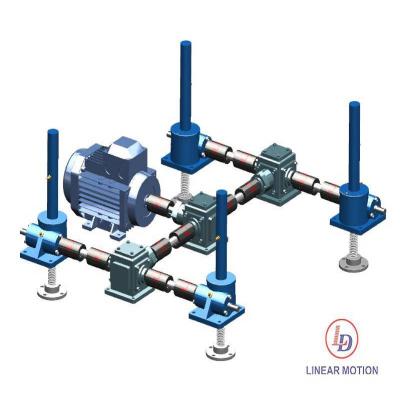
Why a servo motor? The deciding requirement was two actuators working as one. With units 17.37 m apart, both must extend and retract at identical speed. Servo drives in master–slave mode share one encoder reference, so position error between the two units is corrected in real time, keeping the door square. Servo control also provides programmable soft start and stop (an S-curve ramp so a 10–30 t door never jerks), torque/force limiting so the door stops safely if it meets an obstruction, and repeatable end-position control through encoder feedback. Speed can be re-tuned on site between 8 and 16 mm/s without mechanical changes.
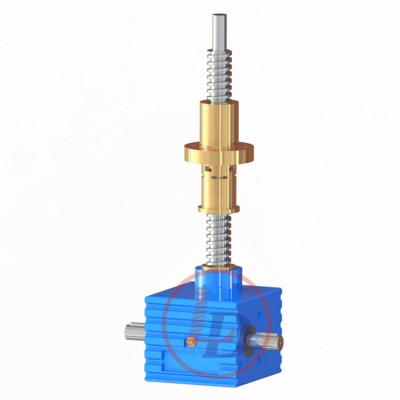
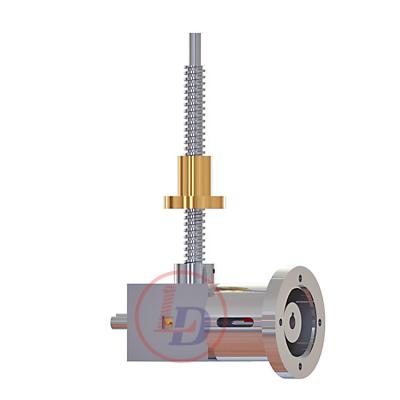
Screw options. The LAP80 is available with two screw types. The acme (trapezoidal) lead screw is self-locking — the door holds its position automatically if power fails — and is maintenance-free with long-life grease, rated for 30% duty cycle; this is the recommended choice for a door used 1–2 times per day. The ball screw (LBP) version offers 100% duty cycle, smoother travel, and higher efficiency, but is not self-locking, so the servo holding brake must engage at standstill. Either way, the servo or an optional BRE brake adds holding redundancy.
Mounting and environment. The LAP80 is fitted with a spherical ball joint head (TS 万向球铰) so that angular misalignment between the actuator and door bracket — unavoidable over a 17.37 m span — is absorbed without side load on the push rod. Standard protection is IP54/IP55, with IP65/IP66 options for dusty or wet hangar environments; operating temperature is 5–40 °C standard, with a −40 °C to +70 °C version available. The catalog load–speed matrix for the LAP80 spans 14 kN at 134 mm/s up to 80 kN at 8.5–17 mm/s, with an even heavier 200 kN option — so the 50 kN, 8–16 mm/s selection is a mid-range, high-margin choice. Beyond the 220 V / 60 Hz servo specified here, the LAP80 accepts DC 12/24/36/48 V, single-phase 220 V, three-phase 380 V, stepper, and explosion-proof motors, with encoder, limit switches, safety clutch, and bellows options.
Selection checklist. Specify: door weight and track friction; wind load on the door face; acceleration margin (safety factor ≥ 2); unit force (14–80 kN per LAP80 unit); stroke equal to door travel; speed for the desired cycle time; duty cycle; power supply (220 V / 60 Hz or 380 V / 50 Hz); mounting and head type; synchronization and limit switch options (FCM magnetic reed, FCP proximity, FCE external); protection class; and fail-safe behavior (self-locking screw or holding brake). For hangar doors, the electric servo solution wins on synchronization, control, cleanliness, and total cost of ownership compared with hydraulic or pneumatic alternatives.
The LAP80 with servo motor from Ludian Transmission replaces hydraulic systems for aircraft hangar doors with maintenance-free, synchronized electric linear motion: 50 kN per unit, 1,100 mm stroke, 8–16 mm/s, ball joint head, and 220 V / 60 Hz servo drive. Send your door weight, leaf width and height, travel distance, and site conditions for a free actuator selection and quotation.